Understanding Amyotrophic Lateral Sclerosis (ALS)
Learn more about the disease we battle, and the families we fight for together.
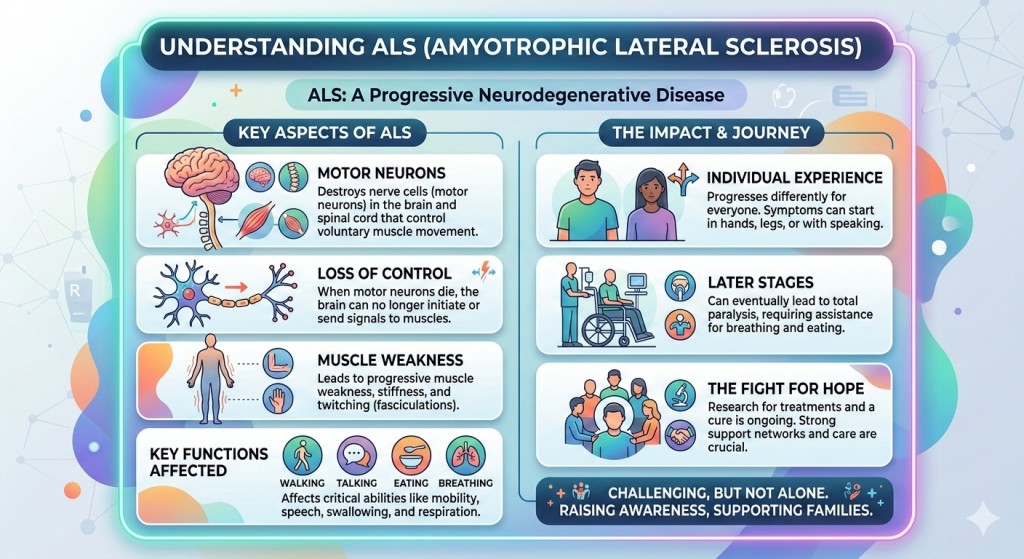
Amyotrophic Lateral Sclerosis (ALS), often referred to as Lou Gehrig’s Disease, is a progressive neurodegenerative disease that affects nerve cells in the brain and the spinal cord.
In simple terms: ALS breaks the connection between the brain and the muscles. When the motor neurons (the “messengers”) die, the brain can no longer initiate or control muscle movement.
Key Facts
It is Progressive: Symptoms usually start with simple muscle weakness or “twitches” in a hand or leg, but eventually spread to affect the ability to move, speak, eat, and breathe.
It is Rare, but Increasing: Approximately 5,000 people are diagnosed each year in the U.S. Experts project that as the population ages, the number of people living with ALS will increase significantly by 2030.
It is Not Just Hereditary: About 90% of cases are sporadic, meaning they occur at random with no family history. Only 10% are linked to genetics.
The Mind Remains Sharp: While the body loses its ability to move, most people living with ALS maintain their intelligence, memory, and personality.
 French
  English (United States)