What is ALS?
UNDERSTANDING ALS
What is Amyotrophic Lateral Sclerosis?
Also known as Lou Gehrig's Disease
ALS is a progressive neurodegenerative disease that affects nerve cells in the brain and spinal cord. It breaks the connection between the brain and muscles — and together, we're fighting to change that.
30,000+
Americans currently living with ALS
5,000+
New cases diagnosed each year in the U.S.
2–5 Years
Average life expectancy after diagnosis
90%
Of cases occur without family history (sporadic ALS)
How ALS Affects the Body
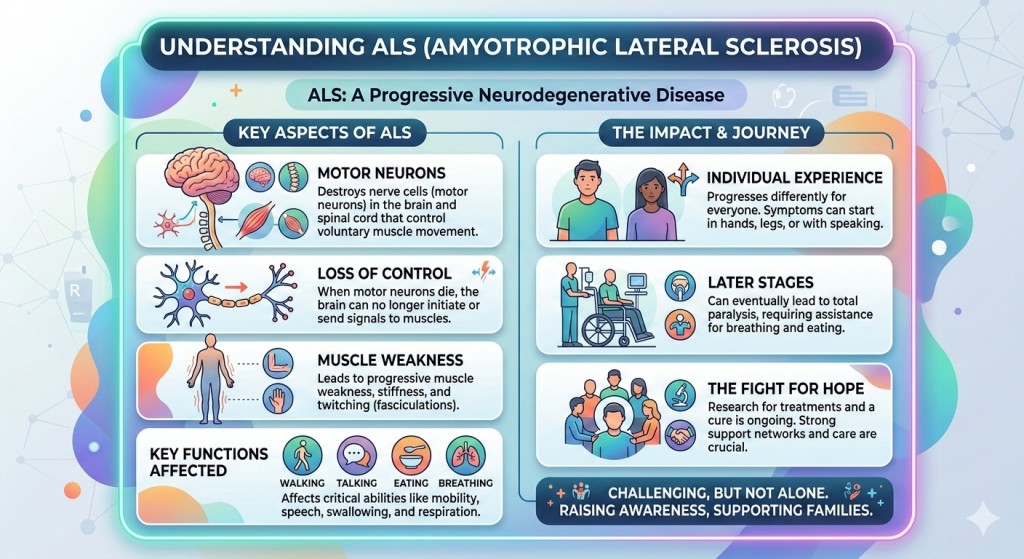
When motor neurons — the messengers between your brain and muscles — begin to die, the body gradually loses the ability to move, speak, eat, and eventually breathe.
🧠
Motor Neurons
ALS attacks the nerve cells responsible for controlling voluntary muscle movement, disrupting signals from brain to body.
⚡
Signal Disruption
As neurons degenerate, the electrical signals that tell muscles to move become weaker and eventually stop entirely.
💪
Muscle Weakness
Without nerve stimulation, muscles weaken and atrophy. Early signs include difficulty gripping, tripping, or dropping things.
📈
Progressive Spread
ALS typically starts in one area — a hand, foot, or tongue — and gradually spreads to other muscle groups throughout the body.
🗣️
Speech & Swallowing
Many people with ALS experience slurred speech and difficulty swallowing as the muscles of the mouth and throat weaken.
🫁
Breathing Difficulty
As respiratory muscles weaken, breathing support becomes necessary. This is the most critical challenge for those living with ALS.


















 English (United States)
  French